

David Osipovitch Widhopff
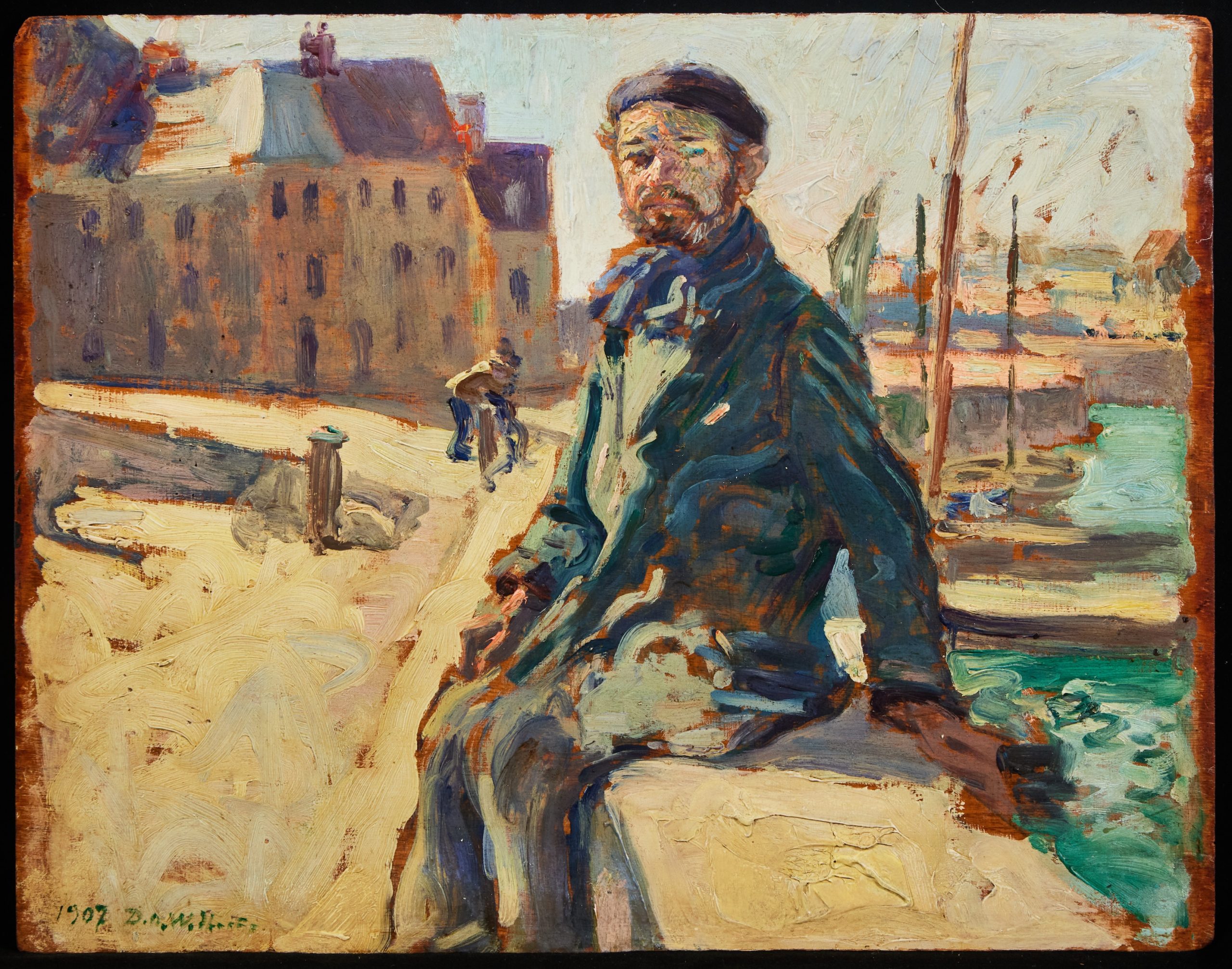
Self Portrait, near the slipway Raie of the old Harbour of Rosmeur at Douarnenez Bay
Provenance:
Private Collection, France
Description:
David Widhopff was an Ukrainian and French painter, caricaturist and poster artist. He was born on 5 May 1867 in Odessa, and gained his diploma at Odessa’s royal academy, before moving to Munich. At the Munich royal academy, Widhopff became a student of Max Herterich. In August 1887, he moved once again, now to Paris. There he entered the Académie Julian, studying there until 1890 under Tony Robert-Fleury and Jules Joseph Lefebvre, with Maurice Denis and Paul Ranson as fellow students. Widhopff keenly followed the styles of William-Adolphe Bouguereau for a while. He exhibited at the Paris Salons of 1888, 1891 and 1893, and travelled to Brazil to set up a fine-arts school in the state of Pará. On his return to Paris, he visited Montmartre and became friends with Alfons Mucha and Léon Deschamps, editor of La Plume. He also met Hugues Delorme and Jules Roques at Le Courrier français, giving rise to a fruitful collaboration with (among others) Willette to provide illustrations for it. At the turn of the century, Widhopff was in the service of the Vollard gallery, which belonged to Ambroise Vollard, one of the most important dealers in French contemporary art in the twentieth century. Vollard had hired him to make posters. He also created tapestries for the Beauvais factory during this time. His association with these two places resumed in the 1920s. He died on 20 July 1933 in Saint-Clair-sur-Epte. During his lifetime, Widhopff earned acclaim for his diverse methods of expression. His uniqueness was his ability to work equally well with both pencil as well as the brush. His drawings are known for their lively expressions, colorful imagery and rich humor.
Signed and dated 1907, the sitter in this portrait is almost certainly the artist himself, then 40 years old. The physical similarities with a self portrait Widhopff painted two decades later, in 1926, and the sitter’s placement in the composition, his remarkably direct, vivid gaze, interacting with the viewer, indicate that we are looking at the painter himself in a harbour setting. As Widhopff is known to have frequented Breton artists and worked in Brittany on the illustration of several local poems and tales in the first decades of the 20th century, the evidence pointed to a harbour in Brittany, with Douarnenez as a likely location (where indeed such houses and walls along the harbour are foundI) and the old harbour of Rosmeur in particular. In fact, the exact location where Widhopff sits in this composition can be situated at the point where the slipway Raie connects to the quay (see ill. x). Douarnenez is a port area, the town and the port are one. Workplaces, factories and residences are all intermingled. All the streets slope down towards the port of Rosmeur. Like the alleys, they are working spaces no less used than the quays. The geography of the place imposes its mark; a simple natural harbour initially offered a few anchorages. Then engineers and technicians built a modest breakwater and a few slipways. These reinforced the natural shelter allowing sailors to make a stopover, but they remained as they were until the development of the platforms in the 1950s. In 1911, the port had up to 800 longboats. These workboats were particularly simple and efficient. The hazards of sardine fishing and economic imperatives led the sailors to practice other types of fishing: drift sardines, skates in winter, line mackerel or drift mackerel in spring. In summer, all fish for sardines with a “straight net”. With 4,560 registered seafarers out of a population of 15,000 in 1910, the sailors gave rhythm to the life of the town.
Widhopff exploited the idea for a composition featuring an artist in a harbour scene again later in his career. Shortly after the present painting, the artist dedicated another harbour scene in 1908-10 to his friend, the Breton artist Jean-Julien Lemordant (1878-1968). The latter work (almost identical to our work: oil on panel, 32 x 41,5 cm) is inscribed at the lower left: “A mon cher Lemordant / de tout coeur D O Widhopff / 1908-1910” (ill. X). Given the fact that Lemordant lived in Saint-Guénolé (Finistère, Brittany) and that the man pushing a cart on the foreground bears a striking resemblance with known portraits of him, It is likely Widhopff portrayed his artist friend on the quay of Saint-Guénolé’s large fishing harbour.