

Charles De Somme
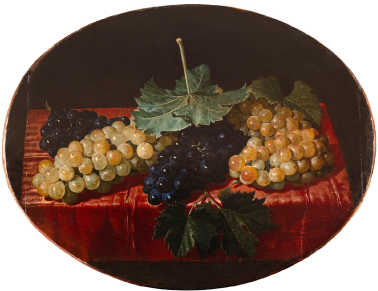
A Still Life of Grapes on a red Velvet Cloth
Provenance:
Private Collection, UK
Description:
An engraving discovered by Claudia Salvi-Faré has led to our better understanding of the life and work of an artist previously believed to be Charlotte Vignon (eg. A Still Life of Peaches and Grapes on a table draped with a red Cloth, Ex collection of Otto Naumann, Sotheby’s New York, 31st January 2018, lot 19). The engraving, by Jacob Coelemans (circa 1670 – 1735), depicts a still life owned by the Aix councillor, Jan-Baptiste Boyer d’Aguilles. Coelemans mentions in his caption, ‘Peint par Somme et grave par Jac.Coelemans’.
Biographical information is very sparse but the catalogue that accompanies the engraving mentions that de Somme lived in Italy and certainly from his paintings we can believe that he was influenced by this stay, in the way that many of his fellow contemporary still life painters were too (like Pierre Dupuis and Nicolas Baudesson). A brief mention in ‘Actes d’état-civil d’artistes français,’ by Henri Herluison in 1873 mentions the artist – “ Charles de Somme peintre de la Reyne, âgé de 36 ans et natif de Bruxelles”. André Félibien also mentions the painter in his first edition of Entretiens (1666-8) – “Le père Zègre, Mario di Fiori, Baudesson auront toujours de la réputation pour les fleurs, de même que Michel-Ange-des-Batailles, Labrador et de Somme pour toutes sorte de fruits, parce-que dans les choses qu’ils ont faites, ils ont acquis un degré de perfection bien plus élevé que celui où sont parvenus beaucoup de peintres qui font des tableaux d’histoire et de portrait”.
De Somme was clearly held in high regard by his contemporaries and may have worked for the Queen. So far eleven paintings are known by his hand which makes this example the twelfth. The strength of de Somme’s compositions lie in their relative simplicity and characterised by a very crisp and realistic treatment of the fruit, as well as bold use of colour. His clever use of the velvet cloth in the majority of his paintings also helps to create a contrast between the soft velvet and the hard freshness of the fruit. This clever and complex use of texture, as well as an obvious accomplished technique, point to an artist of considerable skill, albeit one who remains today, unjustifiably anonymous.