

Jan Victors
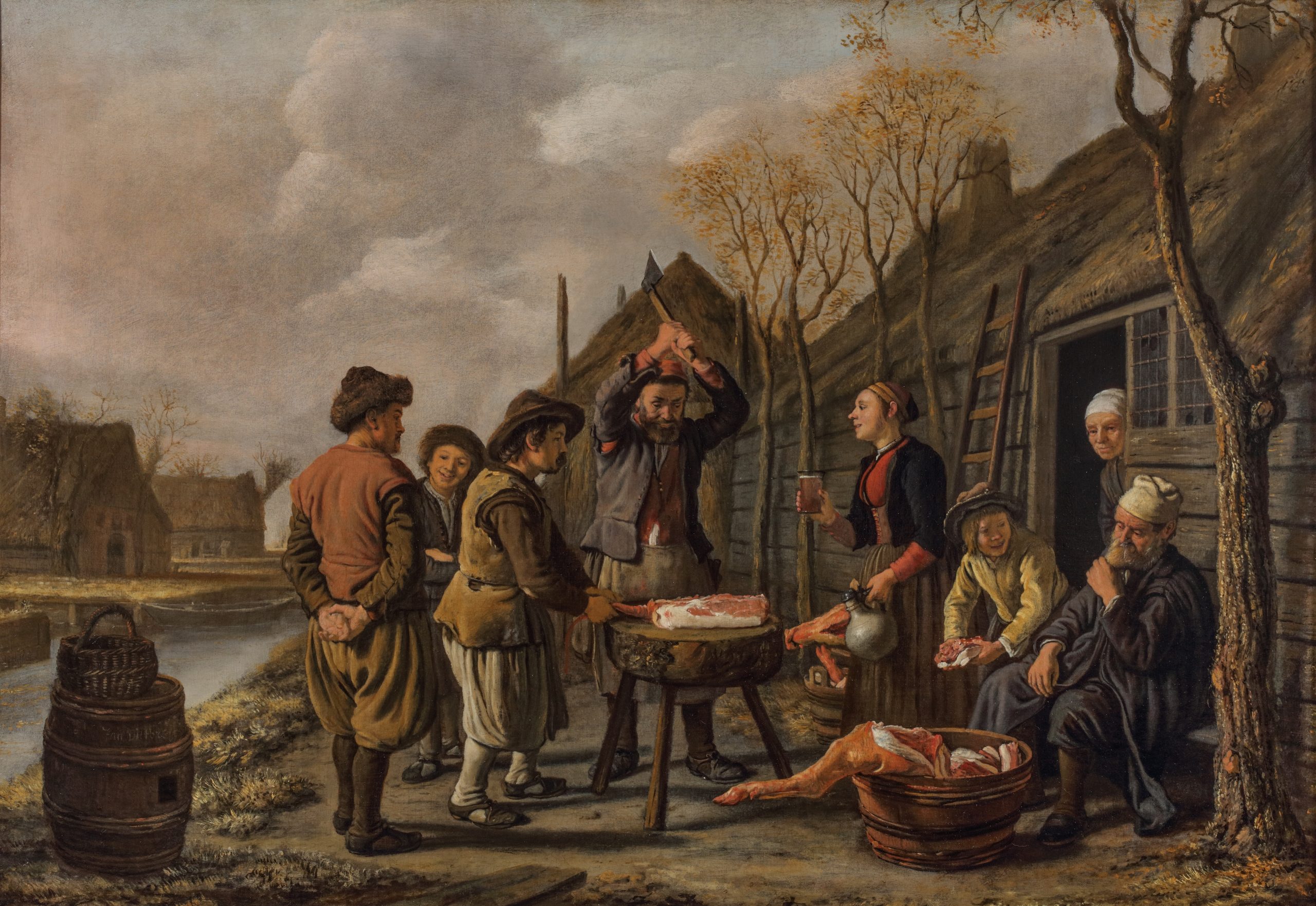
The Village Butcher
Provenance:
Private Collection, Ireland; Ex Collection the Marquis of Waterford; his Sale, Sotheby’s London, 8th December 1971, lot 3
Literature:
“Ireland, a private collection” IV May 1969 no 122; Bob Haak, Hollandse schilders in de gouden eeuw, Amsterdam 1984, p. 367;
W. Sumowski, ‘Gemalde der Rembrandt-Schüler’, Landau, vol 4, 1989, no. 1791; Debra Miller, ‘Jan Victors’, dissertation University of Delaware 1985, 2 vols, cat.no. 98
Description:
Jan Victors was the son of a Flemish chairmaker. Although there is no documentation about this, he is still considered one of Rembrandt’s students. He probably started in the studio in the mid-1630s. His earliest dated works date from 1640. His active period ends around 1670.
Victors was a prolific master. He mainly produced history paintings, all with Old Testament themes, in addition to this there are many genre paintings, some portraits and some figures in fantasy clothing. It is striking that many of the Old Testament works have Jewish subjects that can rightly be called an obscure theme for the average Dutchman. It can be assumed that they must have been intended for Jewish clientele.
His genre paintings are characterized by a high degree of naturalness. The simple village life is in almost all cases centered around a main character with six to eight figures standing around and watching admiringly. The composition is usually the same in its direct simplicity. This painting shows great similarities with a butcher by Victors from the Van der Hoop Bequest in the Rijksmuseum (SK-C-259). The woman offering a glass of beer is a model that he has repeatedly used in various paintings and often in the same dress.
Debra Miller assumed the painting was once one of a pair because the painting was auctioned with another painting by Victors in 1972. However, given the difference in dimensions and compositions, the two paintings would not have been pendants.
It has been suggested that paintings of slaughterers or butchers with a slaughtered ox or a lot of raw meat are vanitas representations. Presumably because in many of these paintings children are playing with a bladder. The question is whether this interpretation is correct. In the sixteenth and seventeenth centuries, in painting and printmaking, the butcher or slaughterer was usually associated with the four seasons or twelve months as the slaughter month, October or November.
The seventeenth-century painter Willem Beurs, who is best known for his painting treatise ‘De groote waereld in t kleen geschildert’ published in Amsterdam in 1692, has a completely different opinion about paintings with food.
He writes that the faithful representation of painted food is entertaining and stimulates the appetite. In a paragraph on Geslagt vlees Rauw en Gekookt Ongezouten en Gezouten (Beaten meat Raw and Cooked, Unsalted and Salted), Beurs writes that painted animals that were intended for consumption, even when depicted alive, entertain people, because when they see ‘het denkbeeld van haare smaake, en van vrolijke geselschappen, daar menze eet, in geheugenis komt.’ (the idea of their taste and of cheerful companies, as people eat them, comes to mind). According to Beurs, the sight of a painting with a pig, sheep, calf or ox shown shortly after slaughter also brings to mind the many tasty winter meals ahead and as a result an overpowering sense of happiness and anticipation.